n-type Bycium+ cells
16 busbars and multi-busbar half-cell construction. Lower temperature coefficient and less light-induced degradation than the p-type modules they replace.
A solar system is a thirty-year commitment made in a single afternoon of purchasing decisions. We specify equipment that will still have a manufacturer behind it, a warranty path in New Zealand and a spare part available when something eventually fails.
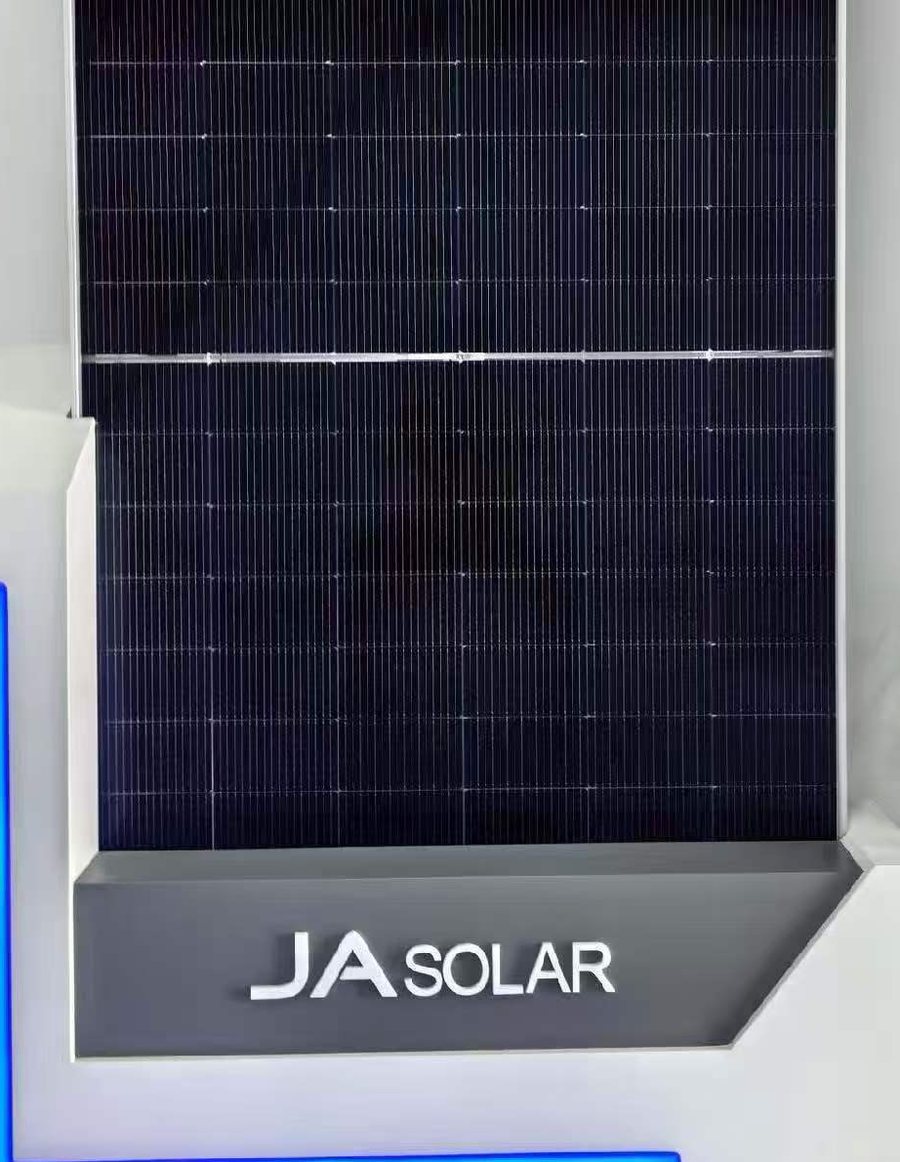
n-type bifacial double-glass, 615 to 640 W, 132 half-cells in a 6 × 22 layout. This is the module we specify by default for commercial and rural work in New Zealand, and the one the figures across this site are modelled on.
16 busbars and multi-busbar half-cell construction. Lower temperature coefficient and less light-induced degradation than the p-type modules they replace.
The rear face converts reflected light. On a light-coloured roof, gravel, sealed carpark or pasture the extra yield is measurable, not marketing.
Anti-reflective coated front glass, heat-strengthened rear glass. No backsheet to yellow, crack or delaminate over the life of the array.
1% degradation in year one, 0.4% per year thereafter — guaranteed at no less than 87.4% of nameplate output in year 30.
Irradiance 1,000 W/m², cell temperature 25 °C, air mass 1.5G. Power tolerance 0 to +3%.
| Type | JAM66D45 -615/LB | JAM66D45 -620/LB | JAM66D45 -625/LB | JAM66D45 -630/LB | JAM66D45 -635/LB | JAM66D45 -640/LB |
|---|---|---|---|---|---|---|
| Rated maximum power (Pmax) [W] | 615 | 620 | 625 | 630 | 635 | 640 |
| Open circuit voltage (Voc) [V] | 48.30 | 48.50 | 48.70 | 48.90 | 49.10 | 49.39 |
| Maximum power voltage (Vmp) [V] | 39.96 | 40.21 | 40.45 | 40.70 | 40.94 | 41.20 |
| Short circuit current (Isc) [A] | 16.10 | 16.13 | 16.15 | 16.18 | 16.21 | 16.24 |
| Maximum power current (Imp) [A] | 15.39 | 15.42 | 15.45 | 15.48 | 15.51 | 15.54 |
| Module efficiency [%] | 22.8 | 23.0 | 23.1 | 23.3 | 23.5 | 23.7 |
Catalogue data is for comparison between module types and does not refer to a single module.
Bifacial nameplate irradiance: 1,000 W/m² front, 135 W/m² rear, cell temperature 25 °C, AM 1.5G. On the 640 W module that is 707 W — roughly 10% more from the same footprint.
| Type | JAM66D45 -615/LB | JAM66D45 -620/LB | JAM66D45 -625/LB | JAM66D45 -630/LB | JAM66D45 -635/LB | JAM66D45 -640/LB |
|---|---|---|---|---|---|---|
| Rated maximum power (Pmax) [W] | 675 | 680 | 685 | 695 | 701 | 707 |
| Open circuit voltage (Voc) [V] | 48.30 | 48.50 | 48.70 | 48.90 | 49.10 | 49.39 |
| Maximum power voltage (Vmp) [V] | 39.96 | 40.21 | 40.45 | 40.70 | 40.94 | 41.20 |
| Short circuit current (Isc) [A] | 17.68 | 17.70 | 17.71 | 17.85 | 17.90 | 17.93 |
| Maximum power current (Imp) [A] | 16.90 | 16.92 | 16.94 | 17.08 | 17.12 | 17.16 |
Custom frame colour and cable length available to order.
Module specifications reproduced from the manufacturer’s datasheet (JA Solar, version Global-EN-20260610A). Specifications are subject to technical change; the manufacturer reserves the right of final interpretation.
Modules are a commodity with a long warranty. Almost every real-world failure we see is in the inverter, the mounting or the connections — so that is where the specification effort goes.
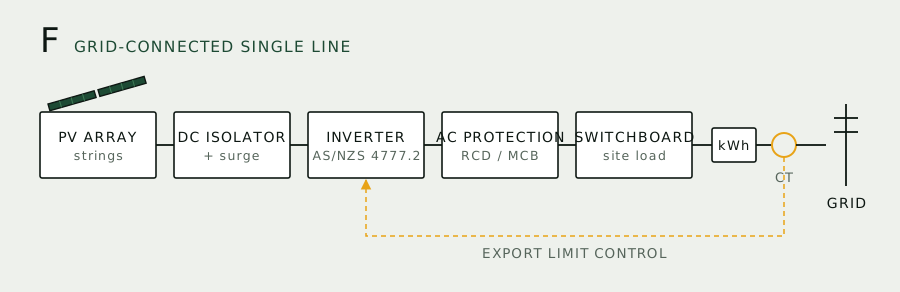
String or central inverters compliant with AS/NZS 4777.2 and listed by the Electricity Authority as accepted for grid connection in New Zealand. We specify for local service support and parts availability, not just headline efficiency.
Engineered systems certified for New Zealand wind zones, selected to suit the cladding: trapezoidal and corrugate steel, standing seam, tile, membrane, ground screw and driven pile, plus purpose-built canopy structures.
DC isolation, surge protection at both ends, correctly rated AC protection, labelling to standard, and a monitoring platform registered in your name with alerting configured before we leave site.
Send us the roof, the load and the constraints. We will come back with a module count, an inverter selection and a layout you can price against anyone else’s.